Bed bug
Cimex lectularius
0.5 mm
Paramere (intromittent organ) length, approximate ('ca 500 µm'); rigid sclerotized structure, so state is immaterial; method and n not stated
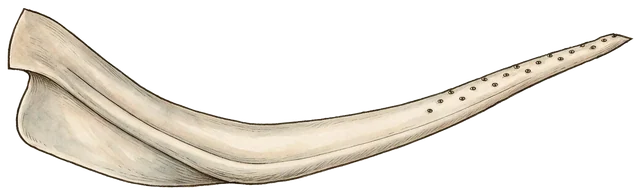
The male has a sickle-shaped spike, the paramere, about 0.5 mm long. He pierces the female's abdominal wall with it and inseminates straight into her body cavity; her genital tract is used only for laying eggs.
Sources
- Matsumura Y., Krings W., Kovalev A., Gorb S.N. (2024) The puncture mechanics: an example from the bed bug Cimex lectularius showing traumatic insemination using the paramere. J. R. Soc. Interface 21:20240108 doi:10.1098/rsif.2024.0108
- Stutt A.D., Siva-Jothy M.T. (2001) Traumatic insemination and sexual conflict in the bed bug Cimex lectularius. Proc. Natl. Acad. Sci. USA 98(10):5683–5687 doi:10.1073/pnas.101440698
Drawn from
- Matsumura et al. 2024, J R Soc Interface, Fig. 5a–b: SEM of the isolated paramere, ventral (a) and dorsal (b) views, with 200 µm scale bars: sickle shape, taper, wing-shaped basal structure
- Stutt & Siva-Jothy 2001, PNAS, Fig. 1A: SEM of the paramere in situ on the male abdomen, lying in its groove, bar = 0.1 mm
- Matsumura et al. 2024, J R Soc Interface, Fig. 1: Habitus schematics of male and female with paramere and spermalege highlighted; mating snapshots