Komodo Dragon
Varanus komodoensis
10.5 cm
Length of ONE fully everted, preserved hemipenis (museum preparation HGD 801), base to apex, measured by us from Böhme's scaled drawing (Abb. 38). Komodo dragons have two; only one is used at a time. The plate shows the pair
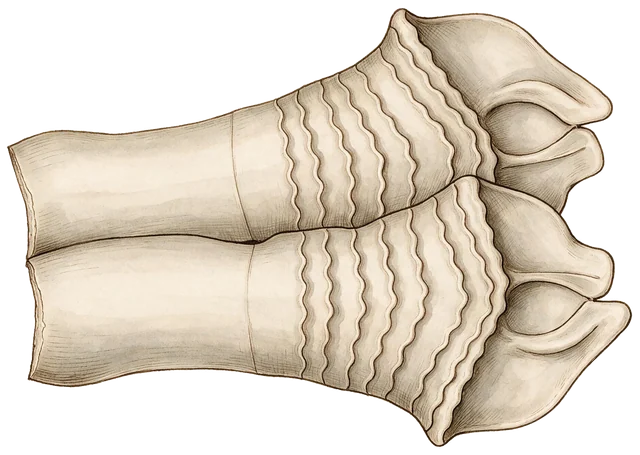
Each Komodo dragon hemipenis ends in two cups, and each cup holds a stiff rod of cartilage. Böhme regarded it as the original, symmetrical type among the large monitors.
Margin note: If the big monitors kept a pattern book, this would be the page marked 'original'.
Sources
- Watts P.C., Buley K.R., Sanderson S., Boardman W., Ciofi C., Gibson R. (2006) Parthenogenesis in Komodo dragons. Nature 444:1021–1022 doi:10.1038/4441021a
- Thompson G.G. (2002) The feasibility of using body proportions in Western Australian varanids (Varanus) as a method for determining a specimen's sex. Records of the Western Australian Museum 20:437–439 link
- Czubaj N. et al. (2024) Biological significance of the Komodo dragon's tail (Varanus komodoensis, Varanidae). Animals 14(15):2142 doi:10.3390/ani14152142
- Böhme W. (1988) Zur Genitalmorphologie der Sauria: Funktionelle und stammesgeschichtliche Aspekte. Bonner Zoologische Monographien 27:1–176. Zoologisches Forschungsinstitut und Museum Alexander Koenig, Bonn link
Drawn from
- Böhme 1988, Abb. 38 a–b (p. 118): Ink drawing of the fully everted hemipenis HGD 801 in sulcal (a) and asulcal (b) views with 2 cm scale bars: slender shaft, club-shaped apex with two cups and hemibacula, paryphasmata. Used for length, proportions and all features